Showing posts with label Book Reviews. Show all posts

9/18/2013

Reading Orthodoxy: Authority and the Adventurer

Matt Anderson and Trevin Wax are hosting a discussion of G.K. Chesterton's Orthodoxy over the next several weeks. Follow along here. The final chapter, 9, is this week.

This last chapter has a lot going for it, and I’m happy to end on a high note after an ambivalent impression of the last few chapters.

I’m still fairly ambivalent about the project of defending Christianity by defending Christian Europe. It seems that Chesterton gives Christianity credit for all the positives, and explains (rather dismissively) all the negatives as a failure to live up to its own ideals. Still, there is plenty that is unique about Europe and I do think that much of it can be credited to Christianity. Even the most secular scientism presupposes Christian values (cf. Nietzsche).

At any rate, there was plenty in this chapter for me to latch on to. Tellingly, I greatly enjoyed the “apologetics” digression, though to Chesterton it seemed like no more than a necessary bore. But Chesterton is right about materialism dismissing miracles based on dogma. There are only a handful of miracles a Christian must believe based on dogma; practically all reports he may evaluate carefully and weigh the evidence. The explanations available to a Christian are not in conflict with the explanations available to a materialist, they are a superset of them. Christianity is not harmed by showing that a miracle was a fraud (save perhaps the resurrection); materialism really is harmed, and fatally, by showing a miracle is not a fraud. And so they adopt an epistemology that guarantees a miracle can never be proved not to be a fraud. I once had an atheist admit to me, almost in these words, that if a miracle were unrepeatable that was grounds for denying that it was real; but if it were repeatable then it would not be a miracle either, simply a lawlike property of nature (here Chesterton might interject that all laws are miracles!).

I’ve often thought you could take Hume’s argument against miracles, with the immense weight it places on humanity’s experience of the world, at face value and still come up with a good argument for miracles (though, strangely, you might not be able to rationally believe in any particular one). That dead men stay dead is enormously well attested. But as Chesterton points out, across all times and places the existence of the supernatural is also enormously well-attested. You can’t accept one body of evidence and not the other without presupposing your conclusion.

But the most powerful idea in this chapter was of Christianity as a living teacher to the soul, and that resonates deeply with me – though to me it is less important if Christianity explains Europe; it certainly explains me. The living teaching I find in the Bible and the church explain, tutor, and nurture my soul in new ways all the time.

9/11/2013

Reading Orthodoxy: The Eternal Revolution and The Romance of Orthodoxy

Matt Anderson and Trevin Wax are hosting a discussion of G.K. Chesterton's Orthodoxy over the next several weeks. Follow along here. Chapters 7 and 8 are this week.

I’m in the strange position of tracking less and less with Chesterton’s argument as he starts discussing Christianity more directly.

This is definitely an argument for Christendom primarily, and the doctrines of Christianity itself only indirectly, insofar as they produced Christendom. In chapter 1 Chesterton claims to be defending Christianity as defined in the Apostle’s Creed, but the focus is definitely on Christian societies and the benefits of Christianity to society.

In chapters 7 and 8, Chesterton makes the case that the ideals of Christianity are actually a better foundation for the goals of secularism, than secularism itself is. Christianity provides the best basis for the reforming of society, for liberty, for love, for democracy. The flow of the argument is wild and creative, as you can expect from Chesterton. But.

In the first place, presenting orthodoxy as nearly synonymous with Christendom, and with Christianity’s capacity for social change, seems to be a small version of Christianity. It is great that Original Sin grounds democracy and equality; and that the Trinity grounds our love for others. But are these the most important things that can be said about Original Sin and the Trinity? Strangely, in a book so focused on narrative and story, he is not telling the story of fall and redemption.

Second is the question of Christianity’s record at some of these social issues. Chesterton says “It does not matter how often humanity fails to imitate its ideal; for then all its old failures are fruitful.” But I think it matters a great deal, especially in an argument such as this, when Christianity fails to imitate its ideal. If Christendom bears little resemblance to the invincible force for social good that Chesterton describes (particularly from the vantage point of a secularist), the obvious conclusion is that Chesterton has mischaracterized Christianity, not that it has just failed to live up to its ideal.

I find the argument much more compelling as a call to Christians for social involvement, and a reminder of the resources we have to draw from to that end, than as a defense of Christianity against competing philosophies.

9/04/2013

Reading Orthodoxy: The Paradoxes of Christianity

Matt Anderson and Trevin Wax are hosting a discussion of G.K. Chesterton's Orthodoxy over the next several weeks. Follow along here. Chapter 6 is this week.

I had a hard time knowing how to approach this chapter, for at least two reasons.

First, the flow of the argument is subtle and hard to follow. He begins by describing the many contradictory ways in which Christianity is criticized, and expresses some skepticism that Christianity, even if it was wrong, could really be that wrong. “It looked not so much as if Christianity was bad enough to include any vices, but rather as if any stick was good enough to beat Christianity with”. He goes on to explain these paradoxical criticisms as being rooted in strange contradictions of the critic, and of modern life, rather than in Christianity. After expressing surprise that Christianity could really be that wrong, he essentially turns to the criticism on its head, painting modernism as really that wrong.

But then he pivots. Maybe the critics are on to something: “There was really an element in [Christianity] of emphasis and even frenzy which had justified the secularists in their superficial criticism”. And he’s off, explaining the thrilling adventure of orthodoxy. “Christianity got over the difficulty of combining furious opposites, by keeping them both, and keeping them both furious”.

That is a complicated argument. But my second problem is that, now that I know what it is, I am not really sure how to evaluate it. It relies heavily on extrapolation to general principles from specific examples. Chesterton is always making throwaway comments about how many examples he has, and how he only has space for a few. But several more examples would have greatly increased my confidence that the examples he cites are getting at something fundamental about Christianity and the objections to it, rather than being specially picked to prove the point.

I suppose that it is an invitation to go digging more than anything else. Chesterton claims to have found these things to be the case wherever he turned. Having got this idea into your head, do you find it everywhere you turn?

8/28/2013

Reading Orthodoxy: The Ethics of Elfland and The Flag of the World

Matt Anderson and Trevin Wax are hosting a discussion of G.K. Chesterton's Orthodoxy over the next several weeks. Follow along here. Chapters 4-5 are this week.

So, The Ethics of Elfland! I liked it so much I will probably not get to The Flag of the World. It has hugely influenced how I think about science and the world.

As I mentioned in my kick-off post, Hume’s critique of any necessary connection between cause and effect really struck me. Surprisingly, not even a probabilistic inference (the sun will probably rise tomorrow because it rose every morning for the past 10,000 years) is valid. His critique was unassailable, and it shook my faith in what I had thought of as the firm things of the world[1].
To my astonishment, Chesterton took this same sentiment (the lack of any real connection between cause and effect) and ran with it: “It is no argument for unalterable law that we count on the ordinary course of things. We do not count on it; we bet on it”
But where he moves next is not to despair but to wonder, in a move so obvious in retrospect I’m a little embarrassed that I hadn’t thought of it that way. How magnificent it is that the world is so regular and predictable! We have no reason to expect it to be so, or even to expect it to be so tomorrow, and yet it is.

Chesterton has somehow maintained the sense of wonder that you find in very young children. As he says, “A child of seven is excited by being told that Tommy opened a door and saw a dragon. But a child of three is excited by being told that Tommy opened a door.” My favorite part of having an infant is getting to observe the wide-eyed wonder with which they regard ordinary things. Everything is new to them, everything is exciting, everything is fascinating. Having children really brought home to me the degree to which we enter the world with no notion at all of what it ought to be like. I think of “how to drink from a cup” to be pretty intuitive, but my one-year-old thought the best way must be to smash his face into the cup.

We’re habituated by long experience to expect the world to be the way that it presents itself to us, and to stop being amazed. But there is no rational basis for this expectation. “When we are asked why eggs turn to birds or fruits fall in autumn…. We must answer that it is magic. It is not a ‘law’, for we do not understand its general formula. It is not a necessity, for though we can count on it happening practically, we have no right to say that it must always happen”.

Here I should say something about what a scientific explanation actually is, because an obvious objection is that we do have a scientific explanation for “why does an egg turn into a chicken”. We certainly know a lot more about the process than we did 100 years ago when Orthodoxy was written, but Chesterton’s is no God-of-the-Gaps critique; it cuts too deep.

This is the point: when we say that science has “explained” something, we like to think that it has told us something about the “why”, but this is false. If I answer the question “why does water boil” with a response about heat causing molecular motion, and matter state changes, and atmospheric pressure, I have only described water boiling in other terms, and in greater detail. I have not answered any “why”questions, I have only relocated them – “why do molecules move faster when they are heated?”, etc. And an answer to that question would still be vulnerable to “why?”, on and on. It follows that no matter how much I increase the detail of the explanation, I cannot answer those fundamental “why” questions[2].  At bottom, we accept the world as we find it, just like an infant does. And (via Hume) our association of experience with necessity is not a rational one.

This is not as bad as it might sound at first; but it does inject a note of humility into science. In spite of all the (very real) scientific advances we have made, the world is still a fundamentally strange and wonderful place that we have not tamed and do not understand.

In fairness to scientists, the ones I know have a healthy sense of wonder in their work. I remember a grad-school professor of mine telling us about his work in Biology: “Whenever I’ve gone wrong in my career, it’s because I wasn’t thinking wildly enough” (emphasis his). And physics, of course, has submitted to the bizarre reality of quantum mechanics since Chesterton’s time, which has mostly killed the physical determinism he describes. Gödel's incompleteness theorem, the Heisenberg uncertainty principle, and the halting problem have contributed to a sense of the limitations of human knowledge[3]. Chesterton would have welcomed all of these developments.

The result is that we live in wonderful and contingent world, made more wonderful precisely because it could have been otherwise. Chesterton conveys a unique sense of enjoyment in these features.


[1] By the way, Hume’s critique of miracles in the last chapter of An Enquiry Concerning Human Understanding is totally incompatible with his dismantling of cause and effect earlier in the same book; so much so that it is fairly common to enlist Hume on cause & effect to critique his own argument against miracles; C.S. Lewis does this in Miracles, and Chesterton takes it to be obvious.
[2] Although a good theory will reduce the number of "why" questions that we have, by explaining phenomena in terms of fewer concepts. For instance, relativity explains why mercury is a liquid, why gold is yellow, and a great many other things.
[3] I can’t pass over the topic without highly recommending Logicomix, a fascinating graphic novel about Bertrand Russell and the search for absolute truth; complete with an examination of the relationship between logic and madness!

8/21/2013

Reading Orthodoxy: The Maniac and The Suicide of Thought

Matt Anderson and Trevin Wax are hosting a discussion of G.K. Chesterton's Orthodoxy over the next several weeks. Follow along here. Chapters 2-3 are this week.

I continue to be impressed by how forthright Chesterton is about his project. In the closing to chapter 3 he explains
Here I end (thank God) the first and dullest business of this book - the rough review of recent thought. After this I begin to sketch a view of life which may not interest my reader, but which, at any rate, interest me.

The Maniac

In the first part of his "rough review of recent thought", Chesterton takes up materialism. The argument, or rather the picture he paints, is of materialism as a species of insanity; in this sense:
As an explanation of the world, materialism has a sort of insane simplicity. It has just the quality of the madman's argument; we have at once the sense of it covering everything and the sense of it leaving everything out... it is not thinking of the real things of the earth, of fighting peoples or proud mothers, of first love or fear upon the sea.
This is something that you either find compelling or you do not; I think there is something to it. Materialism perfectly explains all the small facts of the universe but it does not at all explain the largest and most important ones: love and art, imagination and reason, who we are and what we are doing here. To the extent that it attempts to explain those things it gives dull, empty, unsatisfying answers.

The Suicide of Thought

In Chapter 3 Chesterton defends reason against the modern trends which endanger it: radical skepticism, a false humility which never asserts, and others. But it is a short section on a certain philosophy of evolutionary that I want to highlight. I think, if Chesterton had written Orthodoxy today this would be a longer section.
But if [evolution] means anything more [than that an ape turned slowly into a man], it means that there is no such thing as an ape to change, and no such thing as a man for him to change into.
I remember being deeply affected by a lecture of Dallas Willard's (which I can't locate now) titled roughly "Do humans have a nature?" A "nature" is a common set of characteristics that we possess just by virtue of being human; particularly (in this case) as it relates to human flourishing. Is "a human" an actual, definite thing or is it in flux, defined only by where we are in an evolutionary trajectory and by what we want to be?

Christianity claims that humans have a nature, and that God's moral law is a description of how beings such as we are can flourish in the world we live in. These are facts about what kind of thing a human is; they are walls. You may beat your head against them but you cannot get beyond them by denying their existence.

This runs counter to the popular understanding (influenced, I think, by this philosophy of evolution) that exalts the will and desires an individual chooses to identify with. If you think that lying or having sex outside of marriage, or any other violation of (say) the 10 commandments will contribute to your happiness in a deep, lasting, meaningful sense you are just wrong.

There is a modern tendency to confuse "who we are" with "what we do", and I think it stems from then same problem. If you do not have a nature, then it must be more or less accurate to associate who you are and what you do. But if your identity is wrapped up in what you do, then I can no longer disapprove of your actions without attacking your being; conversations about moral standards will get very heated and very personal very fast.

But if you have a nature, and a soul, then "who you are" is clearly separable from "what you do" and moral conversations are completely different. I can love and value and accept who you are while warning you against destructive behavior; indeed I must warn you precisely because I care about you.

8/14/2013

Reading Orthodoxy: Chapter 1

Matt Anderson and Trevin Wax are hosting a discussion of G.K. Chesterton's Orthodoxy over the next several weeks. Follow along here.

I have a warm relationship with Orthodoxy, because it saved me from David Hume. Flash back to my sophomore year in college, 2 am. I'm sitting in the dorm hallway outside my room, reading Hume's Enquiry Concerning Human Understanding which is due later that day[1]. I am mired in a fog of deep skepticism, pulled in by Hume and unable to argue my way back out. The solid things of the world, like cause and effect, seemed to be giving way before my feet. As my roommate walked by on his way to get ready for bed, I stood up and dropped the book on the floor. "Did you know", I asked him in a defeated voice, "that there is no necessary connection between the book hitting the floor and the sound that it made when it did so?" He just gave me a concerned look and said "Gabe, don't get too screwed up".

It was a year or two later that I read Orthodoxy for the first time, and marveled as Chesterton resolved my crisis in about 2 pages - but more on that when we get to chapter 4, "The Ethics of Elfland".

In Chapter 1 Chesterton lays out the project for his book, in a refreshingly honest way. "I have attempted in a vague and personal way, in a set of mental pictures rather than in a series of deductions, to state the philosophy in which I have come to believe". That is not the way one would expect a book defending Christian orthodoxy to begin. And even more unexpected is the way he intends to do it: "I wish to set forth my faith as particularly answering this double spiritual need, the need for that mixture of the familiar and the unfamiliar which Christendom has rightly named romance".

If this is a need of mine, it is not how I would have expressed it. But to speak of safety, permanence, adventure, and joy as Chesterton does certainly has an allure to it. And to suggest that those qualities of life can uniquely be found in the Christian faith is a fascinating thesis. He later speaks of his theme in different terms: "These essays are concerned only to discuss the actual fact that the central Christian theology (sufficiently summarized in the Apostle's Creed) is the best root of energy and sound ethics". The connection to his "romance of the familiar and unfamiliar" is not immediately clear to me; I'll be watching to see how it plays out in the rest of the book.

But one thing is clear, and it has bothered me somewhat on previous readings of Orthodoxy. Chesterton is not concerned here with whether or not Christianity is true. Or if he is, it is a very inductive argument - "isn't something so astonishing and so unique, and which fills human needs so well, very likely to be true?" The force is more to make you wish it were true than to convince you straightaway that it is. But the thought nags me: does all of this sound so convincing just because Chesterton is a gifted storyteller? Nietzsche, after all, was also a gifted storyteller who could spin a good yarn explaining Christianity.

Those are some of the questions chapter 1 has raised, and I'll be keeping them in mind. Chapters 2 and 3 next week!

[1] I don't recommend ever reading Hume at 2 am.

6/08/2006

This is how we do it in Turlock

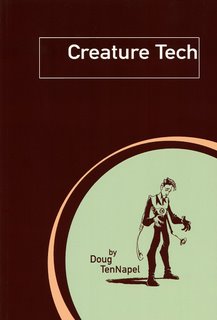
Doug Tennapel's graphic novel Creature Tech is entertaining and unique. I've just read through it (twice) and I'm pretty impressed. This man has the wildest imagination you could possibly imagine. Somehow, though, you don't quite notice how wild the story is while you're reading it. I think this is because the wildness isn't random. Tennapel is not just weaving a whimsical tale about space eels and parasitic alien life forms and a mad scientist who sells his soul to the devil. He is telling a story about faith and a man's journey from naturalism to Christianity. And, somehow, the space eels and alien parasites and mad scientist fit so perfectly into that story that you don't notice how crazy it all is. Until you try to explain the story to someone else. My explanation to Emily of a scene I liked went something like this: "So, this mad scientist has unleashed a bunch of demon-cats on Turlock, and a couple of local hicks are driving around in a truck with a giant mantis killing them. One of the locals pulls out a shotgun and says 'Time to excercise my second-ammendment rights. This is how we do it in Turlock' as he blows a hole through one of the cats." Needless to say, Emily is unconvinced by my claims that there is actually anything serious going on amid all the craziness.

But there is. Creature Tech is the story of Dr. Michael Ong, a genius who dropped out of seminary and became a world-class scientist, relocated by the government to an X-Files-like institute (nicknamed Creature Tech by the locals) in his out-of-the-way hometown of Turlock, CA. When the ghost of an english scientist named Jameson steals the Shroud of Turon from Creature Tech and uses it to resurect his corpse, Michael sets out to stop him from... well, if I told you I think you would stop taking me seriously. Along the way he falls in love with a deformed girl he used to make fun of in high school, picks up a symbiotic alien organism which attaches itself to his chest, and finds himself drawn back to the religion he rejected as a teenager.

Creature Tech can be a little preachy at times, and there are a few moments when the dialog feels forced, which is unfortunate because religion is so integral to the story that I can't help but think it could have been written more naturally. Nevertheless, on the whole Michael's journey to faith is subtle and, if anything, understated. Usually Tennapel lets his art to do the talking, to good effect.

The graphic novel is not exactly the highest art form known to man, so if your literature standards are high don't expect a masterpiece. The characters are interesting and likeably, but not especially deep. Do expect an entertaining, funny, bizzare, and deeply Christian journey through the imagination of Doug Tennapel.

4/30/2006

The Protomen


I have just discovered the coolest thing ever: a Mega Man rock opera by The Protomen. Don't laugh. This is not some lighthearted, silly homage to an old 8-bit video game. It is a serious project with a serious message. While the world in which The Protomen immerse us is obviously indebted to and based on the Mega Man universe, it is not a slave to it. It is a world with pain, fear, doubt, and failure. It is a world that does not follow the neat good-triumphs-in-the-final-cut-scene formula of the video games. This is a much darker, more complex Mega Man.

The opening scene shows us an apocalyptic world in which Dr. Wily and his army of robots rule over the oppressed mass of humanity. Dr. Light, alone in a run-down apartment, labors to create a machine capable of overthrowing Dr. Wily's robots and freeing humanity – thus is Proto Man born. The men of the city rally around Proto Man as he marches toward Wily's fortress, but merely watch as he stands alone against the army of robots. Proto Man fights well, but is overwhelmed in the end and defeated:

The crowd had gathered there to watch him fall, to watch their hopes destroyed. They watched them beat him, they watched them break him, they watched his last defense deployed. There was not a man among them who would let himself be heard. But from the crowd, from the collective fear, arose these broken words: We are the dead.

This is the world into which Mega Man is born. A disillusioned Dr. Light tells him of the failure of his brother, and warns him against making the same mistake: Though it's something that you may not understand – they can't be saved by just one man. These words of Dr. Light's express a major theme of the album: the impossibility of saving from tyranny those who refuse to resist it. This is especially interesting because it is exactly opposite of what happens in the video games: one person, mega man, defeats evil and saves the world mostly by himself. Those whom he saves are off-screen, hardly mentioned.

The Protomen bring them on-screen, and the sight isn't pretty. In the process, they answer a question the video game leaves unanswered: why is Mega Man the lone defender of freedom? Why is it that hope ride alone? The answer seems to be that those being saved simply aren't willing to stand against their oppressors. They cry for liberation but would rather live under tyranny than risk their lives overthrowing it.

Dr. Light's warnings go unheeded by Mega Man, however, and in the best track on the album, The Will of One, he resolves to avenge his brother's death and save mankind, rejecting his father's pleas:

If you say this is how it has to be, you are no better than the fools of this burning city

I won't walk though the entire album, or give away the final climactic scene in front of Wily's castle, but Mega Man's mission ends in failure, as he realizes the truth of his father's words. He removes his helmet (an action usually associated in Mega Man lore with triumph and peace) and it falls from his hands as he turns his back on the crowd and walks slowly away, leaving them to Wily's mercy.

I have to admit being disappointed with the ending. I'm not exactly a Mega Man purist, but fighting Wily is part of his ethos. The concluding scene has more in common with the despair of 1984 than it does with Mega Man. On the other hand, I'm not sure how much that counts as a criticism since it is exactly the point. The ending is as powerful as it is precisely because it departs from the Mega Man formula in such an unexpected way.


At any rate, the album is worth checking out, especially if you have fond memories of defeating Dr. Wily when you were 10. You can download 3 tracks at their website, and listen to 2 more on their myspace page to get a feel for what the music is like.

2/19/2006

Total Truth

I just finished reading Nancy Pearcey's Total Truth. It was reviewed very well, so I decided to read it even though it is a book about worldviews, and I normally cringe whenever I hear the word (often it seems to be just a catchphrase with little substance). Pearcey has some good insights about the holistic nature of Christianity: how its truth ought to encompass and inform everything we do, not just certain activities artificially marked “sacred”. This is certainly something I need to be reminded of. I have a lot of interests, and integrating them into a unified whole so that I am more than just an amalgam of unrelated hobbies is a challenge.

However, I felt the signal-to-noise ratio in the book was pretty low. I found myself wading through a whole bunch of text to reach the point, skimming yet another “Bobby had always thought that religion and science occupied different spheres of authority, until he learned that Christianity is a holistic worldview” story, etc.

To be fair, I am probably not Pearcey's target audience. The idea that Christianity ought to inform how I do everything is not news to me. And I'm already familiar with most of the critiques of Darinism as a worldview that she offers (which is a large part of the book). Still, I couldn't shake the feeling that the book would have been much better if it had been, say, 200 pages instead of 400.

8/30/2005

Moby Dick

I just finished reading Moby Dick. It is amazing. Melville submerges the reader in a flood of symbolism so hauntingly powerful that, even though the meaning completely eludes you, still hits you with such force that at the end, as the last ripples are emanating from the spot recently occupied by the Pequod, the only appropriate response is “whoadang”.

Moby Dick is part enthralling narrative, part rote description of whaling details. In fact, there was less attention paid to Ahab’s maniacal pursuit of the white whale than I expected. Large sections of the book are devoted to the physiology and behavior of whales, the practice of whaling, its history, an apology for it, etc. Moby Dick is an epic not just about the white whale, but about whales and whaling in general. And that’s not all. Libby suggested to me half jokingly that the novel was about everything. Whaling, religion, fate, free will, obsession, man vs. nature, etc., etc., etc. Yeah, “everything” sounds about right.

I’ve heard it suggested that the primary theme is man vs. nature. There is certainly an element of that in the novel’s descriptions of sailing and testosteron-laced whale-killing, but I think the central pursuit of Moby Dick is about something else. The white whale actually strikes me as more deity than nature. He possesses astounding, malicious intelligence, is impervious to harpoons, is occasionally spoken of as a god by the sailors, and seems to act as a guardian of the whales – more than once appearing out of nowhere to bring doom upon a whaling party, allowing the whales being hunted to escape1.

Even in the sometimes tedious descriptive sections, something is going on. Melville will suddenly wax metaphorical and relate some obscure detail of whaling to an aspect of life. I began to wonder if there was any part of whaling that wasn’t like life. At first I suspected there was some common thread tying all these whaling metaphors together ,and if I could just grasp it the novel would fall into place as a unified whole in one of those brilliant moments of clarity that makes reading good literature so worthwhile. But later I decided that there probably was no thread. The point of those metaphorical side-notes, I think, is to establish whaling as a microcosm. The world we encounter over the course of the novel stands for the whole world, Unfortunately, that doesn’t get me any close to an “I get it!” moment of clarity. It just engenders more questions.

Everything seems to have some inscrutable meaning in Moby Dick. Why are all the harpooners pagan? Why do they go down last, each clinging to the top of one of the Pequod’s masts? What in the world is going on between Ahab and Pip? Why did Starbuck get a chain of coffee shops named after him?

That just about exhausts my musings on Moby Dick. I miss being in college and being able to brainstorm with a bunch of smart people who were all reading the same books that I was.


1Of course, nature can appear malevolent and impervious, too. I'm currently reading Into Thin Air, about the tragedy in the summer of '96 when 19 climbers froze to death at the top of mount Everest. The storm that cost those climbers their lives certainly seemed malevolently intelligent and overwhelmingly powerful.